When the Machine Learns to Listen
AI is changing music not only by generating songs, but by widening the circle of who gets to make them, whose voices can be remembered, and how artists may shape sound in the years ahead.
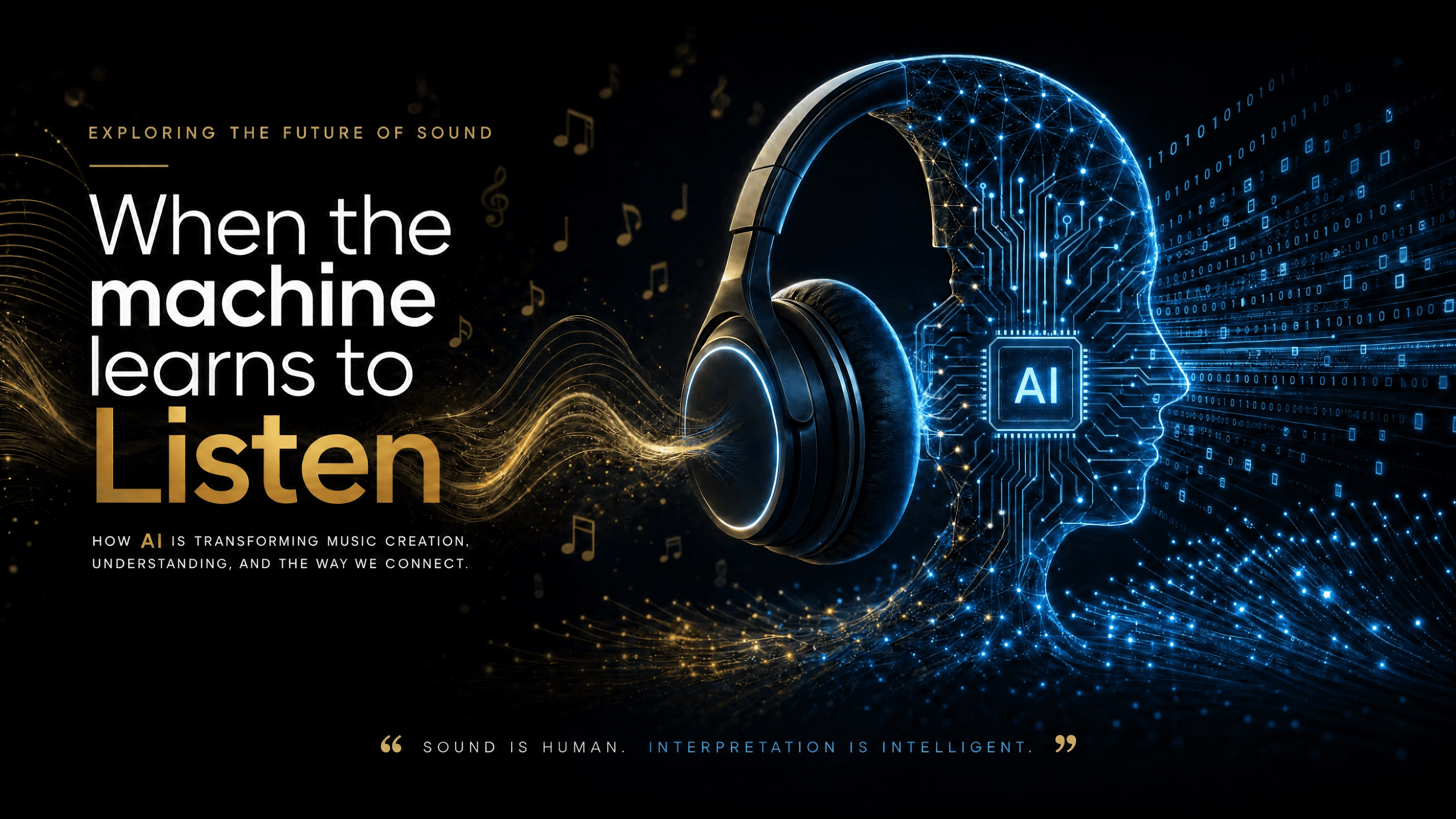
The first instrument was probably not an instrument at all. It was a hand against a chest, a foot on packed earth, a voice answering another voice in the dark. Long before music became an industry, a catalog, a format, or a file, it was a human signal. I am here. I remember. I want you to feel what I feel.
That is why the arrival of artificial intelligence in music feels so charged. It is not merely another software upgrade. It enters a place we reserve for grief, courtship, worship, rebellion, tenderness, and memory. A song can carry the shape of a room you have not entered in twenty years. A chorus can return a person to you for three minutes. When a machine begins helping us make music, we are not asking only whether it can produce a pleasing melody. We are asking whether it can sit near the human heart without crowding it out.
The answer, so far, is complicated and often beautiful. AI music tools can produce complete tracks from text prompts, sketch arrangements from hummed melodies, generate vocals, help restore damaged recordings, and open creative doors for people who have been locked out by the physical demands of traditional instruments and studio software. They also raise urgent questions about consent, copyright, authenticity, ownership, and the quiet dignity of artistic labor.
The story of AI and music is not one story. It is a studio story, a legal story, an accessibility story, an archival story, and a deeply personal story. And like most music history, it is really a story about who gets heard.
From Cave Echoes to Prompt Boxes#
Every era of music has had its controversial machine. The piano was once an engineering marvel. The microphone changed the singer’s body, allowing intimacy to replace projection. Magnetic tape let artists cut time into pieces and stitch it back together. The sampler turned recorded sound into raw material, igniting both entire genres and decades of legal arguments. Auto-Tune began as a correction and became an aesthetic. The laptop made the bedroom a control room.
AI now arrives in that lineage, but with a stranger proposition. Instead of simply changing how musicians capture or manipulate sound, it can participate earlier in the act of making. A person can describe a mood, a tempo, a scene, or a lyric, and receive a piece of music in return. A phrase like “a lonely synth lullaby for a train station at dawn” can become a track. The prompt box becomes a kind of instrument, not because typing is the same as playing cello, but because intention can now travel through language into sound.
This has unsettled many musicians for good reason. Music is not content syrup. It is not wallpaper for engagement funnels. It is a field of practice, lineage, sacrifice, and touch. If AI systems are trained on copyrighted recordings without permission, the problem is not only economic. It is spiritual. Artists hear the possibility that their life’s work could be absorbed, averaged, and resold without their consent.
Yet it would be too small to describe AI music only as theft or a shortcut. In the hands of a careful creator, these tools can behave like a sketchbook that sings back, a collaborator that never tires, or a prosthetic for musical imagination. The question is not whether AI belongs in music. Machines have been in music for centuries. The sharper question is: under what rules, with whose permission, and in service of what kind of creative life?
The most promising future is not one where AI replaces musicians, but one where more people can reach the musical ideas that already live inside them.
The Song Inside a Body That Will Not Cooperate#
To understand the best argument for AI music, do not begin in a venture capital deck. Begin with a musician whose hands no longer obey.
The Independent reported on singer-songwriter Samuel Smith, who has Parkinson’s disease and used AI tools including Suno and Udio while making an album after tremors and stiffness made guitar playing difficult. According to that reporting, he hummed melodies into his phone and used AI-generated arrangements as guides for musicians. There is something quietly profound in that workflow. The song did not disappear when the body changed. It found another path.
Disability often reveals the hidden assumptions built into creative tools. A guitar assumes grip, pressure, reach, and coordination. A piano assumes finger independence. Studio software often assumes vision, fine motor control, and a tolerance for dense visual interfaces. Traditional recording workflows may demand long sessions, complex menus, tiny knobs, and physical stamina. For many disabled creators, the barrier has never been imagination. It has been access to the machinery that turns imagination into sound.
AI can lower that barrier because it accepts different forms of input. A creator may hum instead of play. Speak instead of click. Type a description instead of programming a drum pattern. Iterate through conversation instead of navigating a maze of tracks, plug-ins, and automation lanes. This does not make the work effortless. It makes the doorway wider.
Forbes has reported on blind musician Stephen Lovely using Suno’s screen-reader-friendly interface to create multiple albums. That example matters because accessibility is not only about adding captions or labels after the fact. It is about whether a tool can be understood and controlled by people who do not experience screens in the same way. A prompt-based interface can reduce dependence on visually complex digital audio workstations. It can let musical choice happen through language, listening, revision, and taste.
Researchers are exploring this terrain too. The SoulNote project, described in an academic paper, investigates generative AI songwriting support for Deaf and Hard-of-Hearing individuals, with an emphasis on reflective and iterative song creation. That phrase, “reflective and iterative,” is important. Accessible creativity is not a single magic button. It is the ability to try, respond, revise, and grow. It is the ability to say, “No, not that feeling, this feeling,” until the work becomes recognizable to its maker.
For Deaf and Hard-of-Hearing creators, AI music systems may eventually help translate between lyrics, vibration, rhythm, visual representation, and structure in more fluid ways. For people with limited mobility, they may reduce the need for physically demanding performance during composition. For blind musicians, they may make production less dependent on visual editing. For people with chronic illness, they may compress exhausting setup into short bursts of creative decision-making. For speech-impaired creators, adjacent voice technologies already point toward tools that can preserve vocal identity or enable new forms of expression.
None of this should be romanticized. Disabled musicians do not need AI because they lack artistry. They need tools designed with the understanding that artistry lives in many kinds of bodies. The danger is that companies use accessibility as a halo while neglecting disabled creators in product design, pricing, testing, and credit. The opportunity is much better: build with disabled musicians, pay them, listen to them, and treat their workflows not as edge cases but as clues to a more humane studio for everyone.
When AI helps someone compose after illness has changed their hands, or produce an album without seeing a screen, or explore songwriting through a more accessible interface, it is not replacing musicianship. It is refusing to let musicianship be trapped inside one narrow definition of ability.
The Archive Learns to Breathe Again#
Music has always been haunted by what recording could not save. Wax cylinders cracked. Tapes decayed. Radio performances vanished into the air. Early microphones flattened voices into ghosts of themselves. Sometimes all that remains of a singer is a damaged fragment, a hiss, a pitch wobble, a syllable almost swallowed by time.
AI restoration enters that fragile space with a promise that is both moving and dangerous. It can clean noise, reconstruct missing frequencies, and in some cases generate plausible vocal qualities from limited archival material. Respeecher has reported recreating the voices of Sir Ernest Shackleton and crew members for National Geographic’s Endurance, using degraded 1914 wax cylinder recordings and modern voice actors to help reconstruct historically grounded vocal performances. That is not simply audio repair. It is a historical interpretation through technology.
Other work points toward personal vocal legacy. ElevenLabs’ Impact Program has been described as restoring or recreating voices for people who have lost speech because of ALS, stroke, or neurological conditions, using limited historical audio such as home videos or voicemails. Though this is more speech restoration than music restoration, it belongs in the same moral neighborhood. A voice is not only sound. It is identity, relationship, and presence.
Open-source projects such as VintageVoice, which analyzes pre-1955 public-domain audio to model historical vocal registers and recording characteristics, show another direction: preserving not only notes and words, but the texture of an era. The older microphone coloration, the cadence, the grain of a recorded body in a vanished room. These details are part of musical heritage.
At its best, AI can become a bridge to the archive, helping listeners approach music history with fresh ears. It can make a lost recording intelligible, help museums and filmmakers evoke the past, or allow families to preserve voices that illness has taken away. But a bridge is not a resurrection. The dead cannot consent in the ordinary sense. Estates may grant permission, but legality is not the same as artistic integrity. A restored voice should be clearly disclosed. A reconstructed performance should not be passed off as an untouched artifact. The more intimate the voice, the greater the obligation to tell the truth about how it was made.
This is where authenticity becomes less about purity and more about honesty. We can accept that restoration involves choices. Engineers have always made choices when removing noise, balancing frequencies, or selecting takes. AI makes those choices more powerful, and therefore more ethically charged. The respectful path is not to pretend the machine is absent. It is to name its role, honor the source, secure permission wherever possible, and preserve the difference between memory and imitation.
The New Music Industry Map#
The AI music industry of 2026 is no longer a single fever dream of “type anything, get a song.” It is splitting into several markets, each with its own pressures.
| Company or platform | Current role in the landscape |
|---|---|
| Suno | One of the most visible generative music startups, widely associated with prompt-based song creation and also with major copyright litigation. |
| Udio | A close peer in consumer-facing AI music, reportedly moving toward more licensed remixing and fan engagement models. |
| ElevenLabs Eleven Music | Positioned around scalable AI music production libraries, with reporting indicating licensing relationships with organizations such as Merlin and Kobalt. |
| KLAY | Described as a subscription-based interactive streaming service pursuing secured catalog rights from major music companies. |
| Google Lyria | A developer and cloud-oriented music generation model family, with documented capabilities including text-to-music, lyrics, musical structure control, realistic vocals in multiple languages, image-influenced generation, and SynthID watermarking. |
| Soundverse AI, Starchild Music, SoundSculpt | Examples of more specialized platforms exploring conversational creation, adaptive formats, and real-time soundtracking. |
The dominant trend is licensing. After the first explosion of generative music tools, the industry’s center of gravity has shifted toward negotiation with labels, publishers, artists, and catalog owners. The core dispute remains whether models were trained on copyrighted recordings without permission. Lawsuits and settlements will shape what kinds of tools survive, how artists are compensated, and whether AI music companies become adversaries or infrastructure partners.
Another trend is provenance. Watermarking is becoming a baseline expectation, especially for companies that want to work with established rights holders. Google’s Lyria documentation emphasizes SynthID watermarking, designed to identify AI-generated audio without changing what listeners hear. Provenance will not solve every ethical problem, but it gives the ecosystem a way to ask, “Where did this come from?” That question will matter in streaming, advertising, sync licensing, archives, fan communities, and political media.
A third trend is specialization. Some tools are for consumers who want to make a song quickly. Some are for brands, games, and creators who need adaptive sound. Some are for developers building music into products. Some are for restoration, accessibility, education, or therapeutic contexts. The phrase “AI music” now hides many different use cases. A toy, a prosthetic, a studio assistant, a licensing platform, and an archival tool should not be judged by exactly the same standard.
Still, one standard should apply everywhere: musicians must not be treated as raw material without rights. The future of AI music depends on whether companies can build systems where consent is meaningful, ownership is legible, compensation is real, and listeners are not deceived about what they are hearing.
The Future Composer Has More Than Two Hands#
The phrase “AI-assisted composition” can sound cold, as if the future of music were a committee meeting between a spreadsheet and a synthesizer. But the lived experience may be much warmer. Imagine a songwriter walking home, humming a melody into a phone before it disappears. Imagine a game designer generating a dozen emotional variations for a scene, then handing the best sketches to a composer. Imagine a teenager with limited motor control shaping a chorus through voice notes. Imagine an elder hearing a cleaned and carefully restored recording of a parent singing in a kitchen.
The creative act may become more conversational. Instead of beginning with a blank session, artists may begin with a mood, a memory, a fragment, or an image. They may ask for variations, reject them, splice them, sing over them, or use them as scaffolding for human performance. The value will not be in accepting the first output. It will be in taste, direction, restraint, and the ability to recognize when a track finally tells the truth.
This may also change music education. Students who cannot yet play an instrument may still explore arrangement, genre, rhythm, and lyric structure. They can hear ideas quickly, compare versions, and learn the emotional consequences of musical choices. But education must be careful not to confuse generation with understanding. A person can order a song without knowing how it breathes. The best tools will invite curiosity, not bypass it.
For professional musicians, AI will likely become both a threat and a tool, sometimes in the same week. Background music markets may feel pressure from cheaper generations. Demo-making may become faster. Licensing may become more complex. New roles may emerge around prompt direction, AI arrangement, provenance review, vocal rights management, and hybrid production. The musicians who thrive will not be those who surrender their voice to the machine, but those who learn where the machine is useful and where it must remain silent.
Where Lyria Fits in Springbase#
This brings us to a major step forward in how we interact with these emerging creative tools. We are incredibly excited to introduce the integration of Google’s groundbreaking Lyria model directly into the Springbase platform. This is not about adding another isolated media generator to your dashboard. It is about bringing world-class music generation into a unified workspace where your ideas, documents, and workflows already live.
Lyria is designed to excel at high-quality, long-form music generation, style transfer, and nuanced vocal synthesis. Within Springbase, this capability becomes an extension of your existing creative process. Whether you are building a video campaign, designing an interactive experience, or laying down an initial demo, you can now generate, edit, and orchestrate custom audio assets without leaving the workspace. This integration bridges the gap between structured business planning and raw artistic expression, ensuring that the soundtrack to your next big project is as thoughtful and unique as the ideas behind it.
This is the context in which Google’s Lyria model belongs in Springbase: not as a replacement for the artist, not as a claim that a full music studio has suddenly been automated, but as one more powerful model that can be brought into a larger creative workflow.
Google’s public materials describe Lyria 3 as a music generation model available through Google’s developer and cloud ecosystem. Its documented capabilities include text-to-music generation, support for lyrics, control over musical structure, realistic vocals in multiple languages, image-influenced music generation, and SynthID watermarking for AI-generated audio. Public documentation also describes preview variants for longer studio-quality outputs and shorter low-latency clips.
In Springbase, the meaningful role of a Lyria integration is orchestration. Springbase is positioned as an AI Work OS where work can move from a goal to an editable plan, connected data, execution, an asset, and a reusable recipe. For music-related work, that suggests a practical pattern: a creator, marketer, educator, or media team can frame a creative goal, gather context, shape a plan, and use a model such as Lyria for the music-generation step while keeping the broader workflow organized.
Perhaps that is the right ending, because it is also the right beginning. AI may help us make songs faster. It may help restore voices we thought we had lost. It may help disabled creators reach sounds that older tools kept behind glass. But music’s deepest purpose has not changed. It is still one person sending a signal to another across distance, silence, time, or pain.
The machine can learn patterns. It can learn styles. It can even learn to sing in ways that startle us. But the reason we listen is still human. Somewhere behind the prompt, the model, the archive, the interface, and the waveform, someone is trying to be heard.
Related Posts
The Leadership Clarity Tax: Why Executives Become the Company’s Human Search Engine
When the most informed person in the room is also the only one who can assemble the story, clarity becomes expensive, and progress slows down.
Kimi K3 and the New Question for AI: What Can Your Business Actually Do With It?
A balanced, business-first look at Moonshot AI’s Kimi K3 launch, why its long-context and agentic capabilities matter, where the benchmark story needs caution, and how operating layers like Springbase turn frontier model power into usable work.
GPT-5.6: The Enterprise Control Plane
OpenAI’s new Sol, Terra, and Luna family points toward a more practical operating model for enterprise AI: faster agents, smarter routing, reusable context, and a clearer path from experimentation to real business productivity.